Understanding the Domain Before Designing
The Challenge
Designing Before Understanding Wasn't an Option
Claims management wasn't a domain I was familiar with. Rather than jumping straight into wireframes, I first needed to understand how specialty insurance claims moved from intake to resolution. That meant learning unfamiliar terminology, studying existing workflows, and validating my understanding with stakeholders before making any design decisions.

Legacy Documentation
Existing Workflows
Stakeholder Reviews
Workflow Mapping
Product Understanding
How I Built Context
Each source answered a different question. Legacy documentation explained the existing product, workflow mapping revealed dependencies, and stakeholder discussions helped validate and refine my understanding before I explored interface solutions.
What Changed My Perspective

Claims don't follow a happy path.
My biggest assumption was that claims moved through a predictable sequence. Instead, they frequently looped back, reopened, and changed direction as new information became available.
Investigation drives the workflow.
I expected investigation to be one step in the process. Instead, it became the operational hub where evidence, collaboration, and third-party coordination happened.

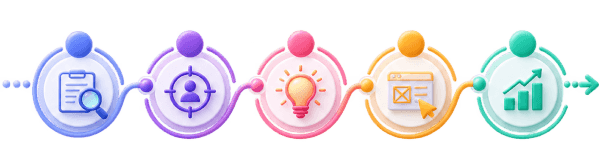
Every stage has a different objective.
Rather than one large claim page, each stage needed its own workspace because users shifted from understanding, to investigating, to evaluating, and finally making decisions.
AI should assist, not decide.
The role of AI wasn't to replace adjusters. It was to surface insights, summarize information, and support better decision-making while keeping humans in control.

I Thought Claims Worked Like This...
My Initial Assumption
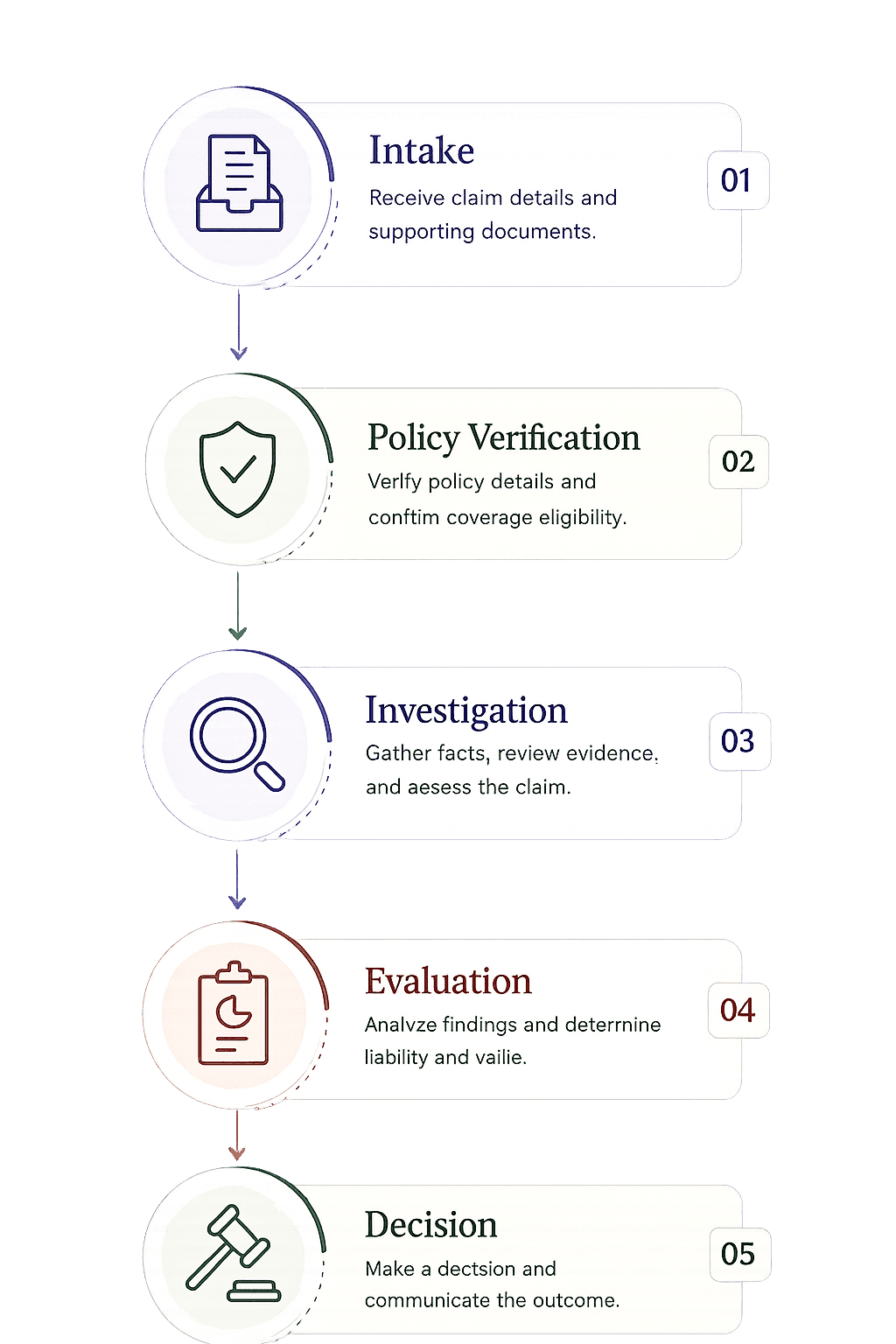
Verify policy details and confirm coverage eligibility.
Gather facts, review evidence and assesses claim.
Analyse the findings and determine liability and value.
Make a decision and communicate the outcome.
Reality

Receive claim details and supporting documents.
Analyse findings and determine liability and value.
Highlights
Designed an end-to-end enterprise claims workflow spanning Intake, Investigation, Evaluation, and Decision.
Translated evolving stakeholder requirements into scalable enterprise workflows.
Built the product by first understanding a complex insurance domain rather than designing from assumptions.
My Role
Sole Product Designer
Timeline
Apr 2026 – Present
Team
Product Leadership · Client Delivery
Responsibilities
Discovery & Research, Workflow Design, UX/UI Design, Stakeholder Collaboration
Domain
Specialty Insurance
Investigation
Evaluation
Decision
Intake
CLAIMS PLATFORM
(Note : Due to confidentiality and intellectual property restrictions, certain product details, visuals, workflows, and business information have been modified or generalized. This case study focuses on the design process, decision-making, and problem-solving approach rather than proprietary implementation details.)
Designing an enterprise claims platform by translating complex insurance workflows into a scalable, decision-focused experience.
Designing an Enterprise Claims Management Platform
Turning Insights into Design Principles
The workflow wasn't the only thing that changed. As my understanding of the domain evolved, so did the principles that guided every design decision across the platform.
Converting Isolated Popups into Dedicated Workspaces
DESIGN DECISION #1
Investigation started as a single popup. But investigation isn't a side task in claims handling, it's the operational core everything downstream depends on: evidence, third-party findings, notes, timeline.
Every time the popup closed, that context disappeared with it.
As the workflow's complexity became clear, it was obvious popups couldn't hold it. Instead, we designed:
Investigation as a full workspace - evidence, findings, timeline always visible
The same shift applied to Evaluation, Negotiation, and Decision.
One consistent workspace pattern reused across every stage
This gave adjusters persistent context instead of re-entering it every time a panel closed, and set the layout pattern every later workspace would reuse.

Home
Investigation Hub
← Back
|
EVIDENCE & DOCS
Inspection_Report.pdf
12MB | Nov 21 2025
Contractor_Quote.pdf
2MB | Nov 24 2025
Repair_Photos.zip
1MB | Nov 24 2025
Witness_Statement.docx
1.2MB | Nov 28 2025
NOTES & FINDINGS
Add a note ...
THIRD PARTY COORDINATION
Northbridge Assessors
Property Damage Assessment
Details >
Estimated Report :
Oct 16, 2025
PROGRESS :
In Progress
Apex Risk Consultants
Liability Assessment
Details >
Estimated Report :
Jan 21, 2025
PROGRESS :
Awaiting Documents
Summit Financial Experts
Financial Loss Review
Details >
Estimated Report :
Dec 22, 2025
PROGRESS :
In Progress
Horizon Claims Services
Site Inspection
Details >
Estimated Report :
Aug 13, 2025
PROGRESS :
In Progress
AI INVESTIGATION FINDINGS
Damage pattern inconsistent
Weather data indicates no hail in the specified region on the date of loss.
Repair estimate cost-heavy
The submitted quote is 32% higher than standard labor rates in London for comparable works.
Proximate cause confirmed
The field surveyor report validates that the primary cause of loss was accidental impact, matching the policy coverage.
CLAIM CONTEXT
🗓 Incident Date
Oct 12, 2025
◎ Loss Location
London, UK
$ Est. Amount
£300,000
🗎 Policy Type
COMMERCIAL
👤 Adjuster
Oliver Cohen
◔ Vendor Status
ASSIGNED
Investigation Hub
CLM-HS-003 • Bloomsberg Corp Ltd • Case Owner: Derek Kent
Search
Search claims, evidence, reports or ask AI...
Assign
Request info
Proceed to evaluation
AFTER
Establishing a Reusable Workspace Architecture
DESIGN DECISION #2
THE CHALLENGE
DESIGN PRINCIPLE
APPLYING THE PATTERN ACROSS THE CLAIM LIFECYCLE
Once Investigation became a dedicated workspace, a new challenge emerged.
Every stage of the claims life cycle solved a different business problem, but users were constantly switching between inconsistent layouts. Instead of redesigning each workspace independently, I focused on creating a reusable interaction pattern that could scale across the platform.

Instead of creating unique layouts for every stage, I established a reusable workspace structure that remained consistent throughout the claims lifecycle while allowing each stage to present different information.
Every workspace followed the same structural blueprint while only the stage-specific module changed.



WHY THIS MATTERED

Designing Around Communication, Not Just Actions
DESIGN DECISION #3
THE PROBLEM
When I first mapped the workflow, I assumed everyone involved would collaborate inside the platform.
As I explored the claims process with stakeholders, I realized something important:
Most external participants; brokers, vendors, surveyors, and policy holders, never use the product directly.
THE DISCOVERY

THE INSIGHT
“Making an offer wasn't the end of the task,it was the beginning of a conversation.”
DESIGN PRINCIPLE
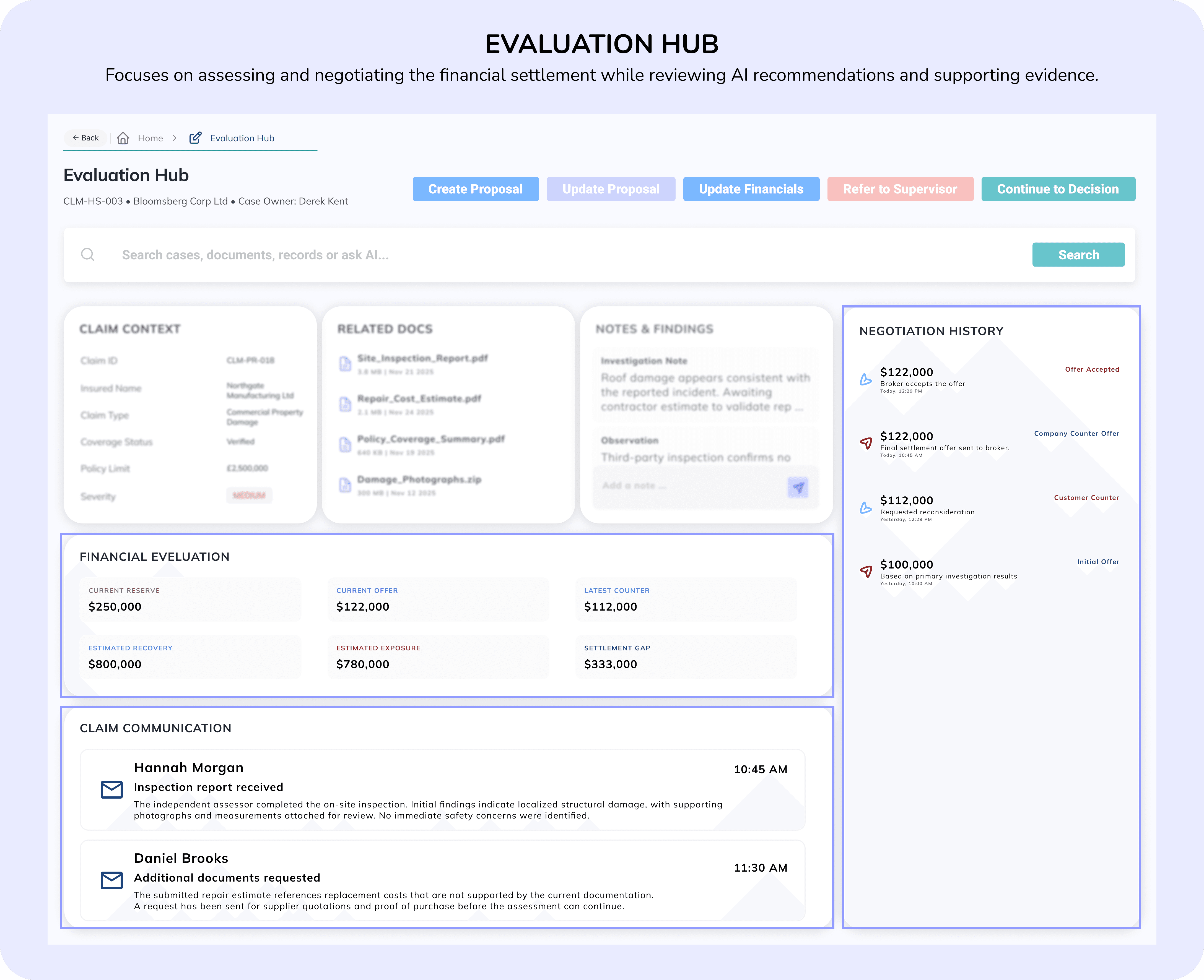
Instead of treating communication as a separate activity, I integrated it directly into the workflow so adjusters could negotiate, communicate, and maintain a complete claim history without leaving the platform.
WHY THIS MATTERED

Home
Evaluation Hub
← Back
|
RELATED DOCS
Site_Inspection_Report.pdf
3.8 MB | Nov 21 2025
Repair_Cost_Estimate.pdf
2.1 MB | Nov 24 2025
Policy_Coverage_Summary.pdf
640 KB | Nov 19 2025
Damage_Photographs.zip
300 MB | Nov 12 2025
NOTES & FINDINGS
Investigation Note
Roof damage appears consistent with the reported incident. Awaiting contractor estimate to validate rep ...
Observation
Third-party inspection confirms no evidence of pre-existing structural deterioration.
Add a note ...
NEGOTIATION HISTORY
$122,000
Broker accepts the offer
Today, 12:29 PM
Offer Accepted
$122,000
Final settlement offer sent to broker.
Today, 10:45 AM
Company Counter Offer
$112,000
Requested reconsideration
Yesterday, 12:29 PM
Customer Counter
$100,000
Based on primary investigation results
Yesterday, 10:00 AM
Initial Offer
FINANCIAL EVELUATION
CURRENT RESERVE
$250,000
CURRENT OFFER
$122,000
LATEST COUNTER
$112,000
ESTIMATED RECOVERY
$800,000
ESTIMATED EXPOSURE
$780,000
SETTLEMENT GAP
$333,000
CLAIM COMMUNICATION
Hannah Morgan
Inspection report received
The independent assessor completed the on-site inspection. Initial findings indicate localized structural damage, with supporting photographs and measurements attached for review. No immediate safety concerns were identified.
Daniel Brooks
Additional documents requested
The submitted repair estimate references replacement costs that are not supported by the current documentation. A request has been sent for supplier quotations and proof of purchase before the assessment can continue.
10:45 AM
11:30 AM
CLAIM CONTEXT
Claim ID
CLM-PR-018
Insured Name
Northgate Manufacturing Ltd
Claim Type
Commercial Property Damage
Coverage Status
Verified
Policy Limit
£2,500,000
Severity
MEDIUM
Evaluation Hub
CLM-HS-003 • Bloomsberg Corp Ltd • Case Owner: Derek Kent
Search
Search cases, documents, records or ask AI...
Create Proposal
Update Proposal
Update Financials
Refer to Supervisor
Continue to Decision

Email is sent and automatically logged inside Claim Communication and Negotiation History
Adjuster creates counter offer.
A single action updated three parts of the product - external communication, negotiation history, and the claim record; eliminating duplicate work.
AI as a Co-pilot, Not a Decision Maker
DESIGN DECISION #4

THE PROBLEM
Throughout the claims lifecycle, adjusters reviewed large volumes of evidence, reports, policy documents, and financial information before making decisions.
While AI could accelerate this work, stakeholders were clear that final claim decisions had to remain with the adjuster.
THE INSIGHT
“The goal wasn't to automate decisions - it was to reduce the effort required to make them.”
WHY THIS MATTERED

DESIGN PRINCIPLE
Rather than automating claim decisions, AI was integrated at key moments where it could reduce cognitive effort while preserving human judgment.

Case study optimized for desktop. Tablet and mobile versions are coming soon.
Case study optimized for desktop.
Tablet and mobile versions are coming soon.
This project changed the way I think about enterprise product design. I started by designing interfaces, but I quickly learned that the real challenge was understanding the operational workflow behind them.
Reflection
“Consistency in the workflow pattern mattered more than any single screen looking unique.”

WHAT I LEARNT
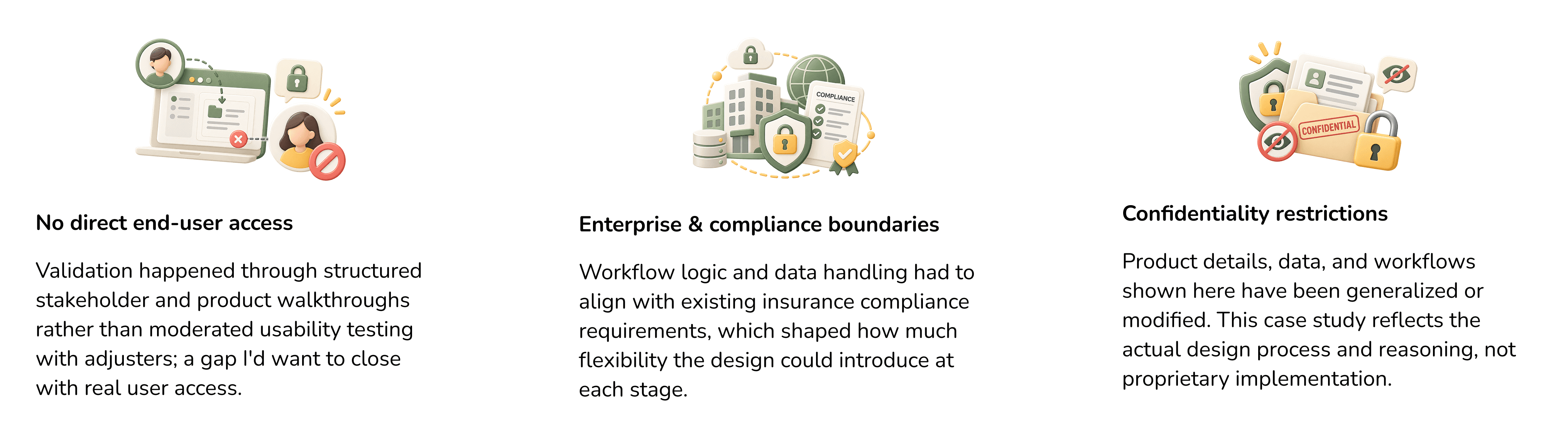
CONSTRAINTS I WORKED WITHIN
IF I CONTINUED THIS PROJECT I’D LIKE TO
Run usability testing directly with adjusters to validate the workspace pattern under real caseloads
Measure task completion time across stages to confirm the reusable architecture actually reduces effort, not just navigation friction
Test AI explanation clarity - do adjusters trust and correctly interpret the AI's findings, or do they just click through?